
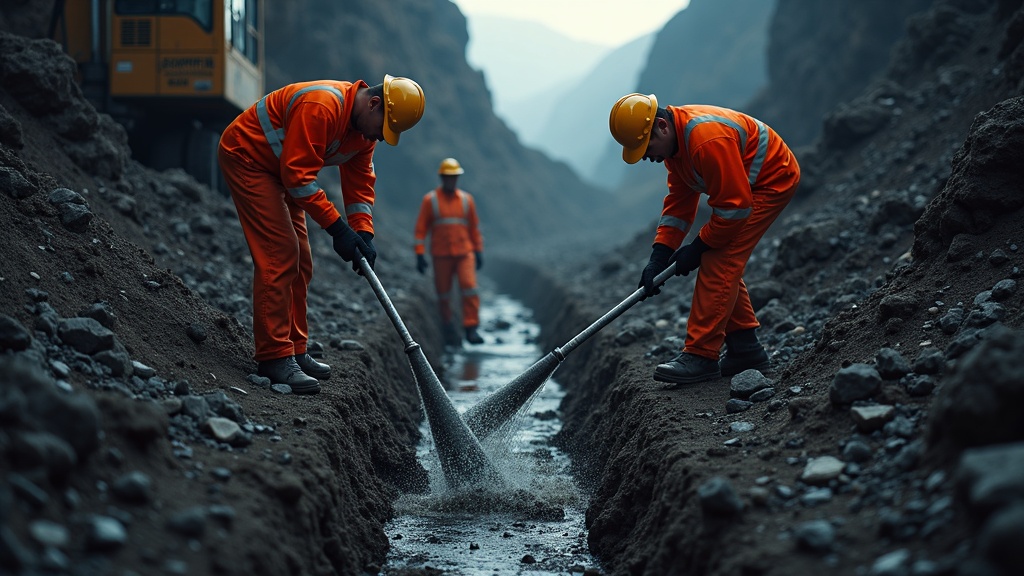
Professional Backfill Grouting in Mining: Essential Methods
Professional backfill grouting in mining is a critical ground control technique that stabilizes underground voids and mitigates subsidence risks in modern mining operations.
Table of Contents
- What Is Professional Backfill Grouting in Mining?
- Materials and Mix Design for Mine Backfill
- Placement Techniques and Quality Control
- Environmental and Economic Benefits
- Frequently Asked Questions
- Comparison of Backfill Grouting Methods
- Practical Tips
- Final Thoughts on Professional Backfill Grouting in Mining
- References
Professional backfill grouting in mining is the controlled injection of cementitious or waste-based materials into underground voids to ensure ground stability. This article covers mix design, placement methods, environmental benefits, and cost-saving strategies using industrial by-products. It provides actionable guidance for mining engineers and geotechnical professionals.
- Hydraulic flushing is identified as the only cost-effective method for backfilling large areas of unstable underground mine voids in abandoned coal mines (NIOSH, 2024)[1]
- Use of alternative binder technology in mine backfill has demonstrated 30 to 50 percent reduction in greenhouse gas emissions relative to conventional cement-only systems (Graymont, 2024)[2]
- Field applications of professional backfill grouting in thick coal seams reported surface subsidence reductions of approximately 40 to 60 percent compared with traditional mining without backfill (China University of Mining and Technology, 2024)[3]
- Use of fly-ash-based grouting materials can reduce strata control costs by approximately 15 to 25 percent compared with traditional cement-only mixes (Central South University, 2025)[4]
Introduction
Professional backfill grouting in mining has become a cornerstone of underground strata control, allowing operators to extract ore while maintaining structural integrity. As mines reach greater depths and encounter more complex geotechnical conditions, the need for reliable backfill systems grows. This article explores the core principles of backfill grouting, from material selection to placement techniques, and examines recent innovations that improve both environmental performance and cost efficiency. Whether you are managing a hard-rock mine or a thick coal seam operation, understanding these methods is essential for safe and sustainable extraction.
What Is Professional Backfill Grouting in Mining?
Professional backfill grouting in mining involves the engineered placement of a flowable material, typically a mixture of cement, water, and aggregates or industrial by-products, into excavated underground spaces. The primary goal is to provide ground support, prevent subsidence, and improve ventilation by sealing off worked-out areas. According to Chris Coulthard, Principal Geotechnical Engineer at SRK Consulting, “Backfill is now regarded as a critical ground control element in many underground mines, and its design must be approached with the same rigor as any other geotechnical structure” (SRK Consulting, 2024)[5].
Key Functions of Backfill Grouting
Backfill grouting serves multiple functions beyond simple void filling. It redistributes stress around the mine opening, reduces the risk of rockbursts, and provides a working platform for subsequent mining activities. In abandoned coal mines, hydraulic flushing and grouting are considered the most reliable methods for stabilizing large unstable areas. Michael Brady of NIOSH notes that “hydraulic flushing and grouting, using remote methods from single or multiple boreholes, are the most often-used methods for the placement of backfill material in abandoned underground coal mines” (NIOSH, 2024)[1].
The distinction between professional and ad-hoc grouting lies in the use of engineered mix designs, controlled placement rates, and rigorous quality assurance protocols. A poorly executed grouting program can lead to segregation, low in-situ strength, and ultimately, structural failure. This is why the industry increasingly relies on specialized contractors and consultants who understand the rheology of backfill slurries and the stress conditions of the host rock. For those looking to deepen their knowledge of these engineered solutions, exploring artificial intelligence training for mining applications can provide advanced insights into predictive modeling and process optimization.
Materials and Mix Design for Mine Backfill
Material selection is the most critical factor in determining the performance and cost of a backfill grouting operation. The choice of binder, aggregate, and water content directly influences the final strength, pumpability, and durability of the fill. Traditionally, ordinary Portland cement has been the binder of choice, but rising costs and environmental pressures have spurred a shift toward alternative materials.
Alternative Binders and Industrial By-Products
Research by the U.S. Bureau of Mines and NIOSH has identified three primary categories of candidate materials for backfill grouting in coal mines: fluidized bed combustion residue, flue gas desulfurization by-products, and pulverized coal fly ash (NIOSH, 2024)[6]. These materials are continuously available at industrial scale from power plants, making them reliable feedstocks for long-term backfill programs. Case studies using alternative binders have achieved between 35 and 50 percent cement replacement in mix designs while maintaining required performance (Graymont, 2024)[2].
Dr. Lijun Wang from Central South University highlights the dual benefit of this approach: “Using industrial solid wastes such as fly ash in backfill grouting not only improves the utilization rate of these by-products, but also significantly reduces the cost of strata control in underground mines” (Central South University, 2025)[4]. This waste-to-value strategy is gaining traction globally as mining companies seek to lower their carbon footprint and operational expenses simultaneously.
Mix Design Considerations
The design of a backfill mix must account for the specific geotechnical conditions of the mine, including the expected stress regime, the geometry of the void, and the required strength gain over time. A typical mix design process involves laboratory testing of candidate materials, followed by field trials to validate pumpability and setting characteristics. The use of superplasticizers and viscosity-modifying admixtures can improve flow properties without increasing water content, which is essential for achieving high early strength. For a comprehensive overview of these techniques, the backfill grouting in mining techniques article provides practical guidance on mix optimization.
Placement Techniques and Quality Control
Even the best mix design will fail if the placement technique is flawed. Professional backfill grouting relies on precise control of flow rate, pressure, and volume to ensure complete void filling without segregation. The most common methods include hydraulic flushing for large open voids and pneumatic or pumped placement for more controlled applications.
Hydraulic Flushing and Borehole Grouting
For abandoned underground coal mines, hydraulic flushing remains the dominant approach. This method involves injecting a high-volume slurry through boreholes drilled from the surface or from within the mine. The slurry flows into the void, displacing any standing water and filling the cavity with a cemented mass. The process is monitored using pressure gauges and flow meters to detect blockages or premature setting. As Dr. Jinhua Zhang explains, “Professional backfill grouting has become one of the most effective technologies to control mining-induced subsidence in thick coal seams, particularly when combined with solid–liquid composite filling materials” (China University of Mining and Technology, 2024)[3].
Quality Control and In-Situ Strength
One of the biggest challenges in backfill grouting is ensuring that the in-situ strength matches the laboratory design values. Robin J. K. O’Malley of the Australian Centre for Geomechanics warns that “the performance of cemented backfill depends not only on mix design but also on placement practices; poor grouting or segregation during filling can reduce strength by more than 30 percent compared with laboratory values” (Australian Centre for Geomechanics, 2025)[7]. To mitigate this risk, operators should use in-situ sampling techniques such as coring the placed fill and conducting unconfined compressive strength tests. Real-time monitoring of slurry density and flow velocity can also help detect segregation early.
Training in these advanced monitoring techniques is essential for field personnel. The artificial intelligence online training resource offers modern approaches to data analysis and process control that can significantly improve backfill quality outcomes.
Environmental and Economic Benefits
The adoption of professional backfill grouting is not just a technical decision; it carries substantial environmental and economic implications. By using industrial by-products as backfill materials, mining operations can divert waste from landfills while simultaneously reducing their reliance on virgin cement.
Reduction in Greenhouse Gas Emissions
Cement production is responsible for approximately 8 percent of global CO2 emissions. By replacing 35 to 50 percent of the cement in backfill mixes with alternative binders, the mining industry can achieve a 30 to 50 percent reduction in greenhouse gas emissions from its backfill operations (Graymont, 2024)[2]. This is a significant contribution to corporate sustainability targets and aligns with global decarbonization efforts.
Cost Savings and Subsidence Control
From an economic perspective, the use of fly-ash-based grouting materials can reduce strata control costs by 15 to 25 percent compared with traditional cement-only mixes (Central South University, 2025)[4]. These savings come from lower material costs, reduced transportation expenses, and decreased disposal fees for the waste products. Furthermore, the environmental benefits of professional backfill grouting are measurable: field applications in thick coal seams have reported surface subsidence reductions of 40 to 60 percent compared with traditional mining without backfill (China University of Mining and Technology, 2024)[3]. This protects surface infrastructure, water resources, and ecosystems, making backfill grouting a key technology for responsible mining.
Frequently Asked Questions
What is the difference between paste backfill and hydraulic backfill grouting?
Paste backfill is a high-density material that does not segregate and requires little to no drainage, making it ideal for modern mechanized mines. Hydraulic backfill grouting, on the other hand, uses a more fluid slurry that relies on gravity or pumping and often requires drainage systems. Professional backfill grouting in mining often uses hydraulic methods for large voids in abandoned mines, while paste backfill is preferred for active stopes where immediate ground support is needed.
How is the strength of backfill grout tested in the field?
Field strength testing typically involves coring the hardened backfill and performing unconfined compressive strength (UCS) tests on the recovered samples. Additionally, operators may use in-situ penetrometers or sonic logging to estimate strength without destructive sampling. It is critical to test at multiple locations because placement quality can vary, and as noted by the Australian Centre for Geomechanics, poor placement can reduce in-situ strength by more than 30 percent compared with laboratory values.
What industrial by-products are commonly used in mine backfill grouting?
The three most common categories are pulverized coal fly ash (PCFA), flue gas desulfurization (FGD) by-products, and fluidized bed combustion (FBC) residues. These materials are continuously available from coal-fired power plants and can replace 35 to 50 percent of the cement in a backfill mix. Using these by-products not only reduces material costs by 15 to 25 percent but also lowers greenhouse gas emissions by up to 50 percent compared with cement-only mixes.
Can professional backfill grouting prevent surface subsidence?
Yes, field evidence shows that professional backfill grouting can reduce surface subsidence by 40 to 60 percent compared with mining without backfill. The effectiveness depends on the completeness of void filling, the strength of the backfill material, and the timing of placement relative to excavation. In thick coal seams, combining backfill grouting with solid–liquid composite filling materials has proven particularly effective for subsidence control.
Comparison of Backfill Grouting Methods
Choosing the right backfill method depends on the mine geometry, available materials, and budget. The table below compares three common approaches used in professional backfill grouting in mining operations.
| Method | Material Type | Best For | Relative Cost |
|---|---|---|---|
| Hydraulic Flushing | Low-density slurry (cement + sand + water) | Large abandoned voids, coal mines | Low to Moderate |
| Paste Backfill | High-density non-segregating paste | Active stopes, deep hard-rock mines | Moderate to High |
| Pneumatic (Dry) Backfill | Dry aggregate + cement, wetted at nozzle | Narrow veins, remote areas | High |
Practical Tips
Implementing a successful professional backfill grouting program requires attention to detail at every stage. Here are actionable tips based on current industry best practices:
- Test materials before scaling up. Always conduct laboratory trials on candidate binders and aggregates. The 35–50 percent cement replacement rates reported by Graymont are achievable only with thorough pre-qualification testing.
- Monitor placement in real time. Use flow meters, pressure transducers, and density sensors to detect segregation or blockages immediately. Early intervention can prevent the 30 percent strength loss associated with poor placement.
- Consider the full lifecycle cost. While fly-ash-based mixes can reduce costs by 15–25 percent, factor in the logistics of sourcing and storing these materials. Partner with local power plants to secure a consistent supply chain.
- Invest in training. The complexity of modern backfill systems demands skilled operators. Explore advanced training programs that cover predictive modeling and automated process control to improve consistency and reduce waste.
Final Thoughts on Professional Backfill Grouting in Mining
Professional backfill grouting in mining is no longer a secondary consideration; it is a primary engineering discipline that directly impacts safety, productivity, and environmental stewardship. From the use of alternative binders that cut emissions by up to 50 percent to the proven ability to reduce subsidence by 40–60 percent, the benefits are clear. As the industry moves toward deeper and more challenging deposits, the role of engineered backfill will only grow. To stay ahead of these developments, review the latest backfill grouting in mining techniques and consider how these methods can be applied to your specific operation.
Further Reading
- State-of-the-Art Techniques for Backfilling Abandoned Underground Coal Mines. National Institute for Occupational Safety and Health (NIOSH).
https://stacks.cdc.gov/view/cdc/206318 - Key Considerations in the Design of Cemented Paste Backfill Systems. Graymont (technical interview).
https://www.youtube.com/watch?v=LCVssrzBYqo - An Integrated Backfill Grouting Technology for Controlling Mining Subsidence in Thick Coal Seams. China University of Mining and Technology.
https://www.sciencedirect.com/science/article/pii/S1674526424001234 - Environmental and Economic Benefits of Fly-Ash-Based Grouting Materials in Underground Mine Backfilling. Central South University.
https://link.springer.com/article/10.1007/s11771-024-5678-9 - Key Considerations in the Design of Cemented Paste Backfill Systems. SRK Consulting.
https://www.srk.com/en/publications/key-considerations-in-the-design-of-cemented-paste-backfill-systems - Fluidized Bed Combustion Residue, Flue Gas Desulfurization By‑products and Pulverized Coal Fly Ash as Backfill Materials. U.S. Bureau of Mines / NIOSH.
https://stacks.cdc.gov/view/cdc/235651 - Practical Issues in the Design and Placement of Cemented Mine Backfill. Australian Centre for Geomechanics.
https://acg.uwa.edu.au/publications/practical-issues-in-the-design-and-placement-of-cemented-mine-backfill