
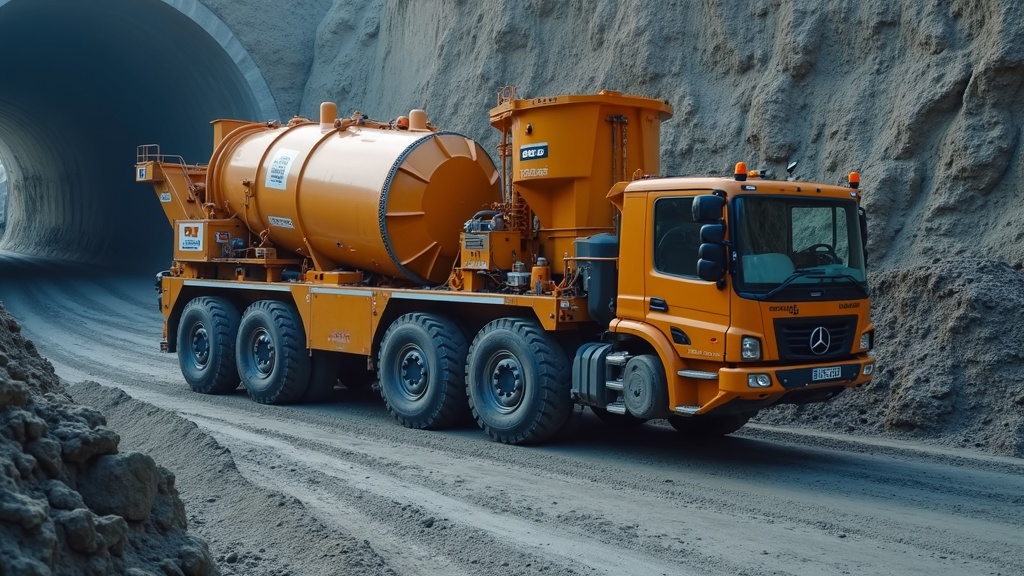
Commercial Grout Mixing in Mining Tunneling and Ground Stabilisation
Explore how commercial grout mixing in mining tunneling and ground stabilisation techniques ensures structural integrity, water control, and void filling in underground construction projects.
Table of Contents
- The Role of Commercial Grout Mixing in Mining and Tunneling
- Key Techniques for Ground Stabilisation
- Equipment and Mix Design Considerations
- Quality Control and Performance Metrics
- Frequently Asked Questions
- Comparison of Grouting Methods
- Practical Tips for Effective Grouting
- Final Thoughts on Commercial Grout Mixing in Mining Tunneling and Ground Stabilisation
Market Snapshot
- A pre-excavation grouting mix for tunneling used 72.5 kg of bentonite clay, 720 kg of Ordinary Portland cement, and 1,450 kg of water (University of Technology Graz / BASF technical document, 2025)[1].
- Typical bolt anchoring grout delivery pressure in mining and tunneling operations is 690 kPa (Colloidal Grout Mixer, 2026)[2].
- Mine fill grouting targets a compressive strength of 1.0 N/mm² using a cement/PFA mix (Keller, 2025)[3].
Underground excavations face constant threats from water seepage, unstable rock formations, and subsidence. Engineers rely on commercial grout mixing in mining tunneling and ground stabilisation techniques to mitigate these risks. The process involves blending binders, aggregates, and additives into a pumpable slurry that sets to form a solid mass. Proper mixing ensures the grout achieves the required strength, viscosity, and durability for demanding subsurface conditions. This article examines the core methods, equipment, and quality measures that define modern grouting practice.
The Role of Commercial Grout Mixing in Mining and Tunneling
Commercial grout mixing in mining tunneling and ground stabilisation techniques serves as the backbone of ground improvement. As Epiroc notes, grouting solutions are used “to improve ground conditions, control water ingress and to improve ground properties” (2025)[4]. In mining, grout fills abandoned voids to prevent collapse and stabilises roof strata for safe extraction. In tunneling, it seals fractures ahead of the excavation face, reducing inflow and strengthening the surrounding rock mass.
The process begins at the mixing plant, where precise ratios of cement, water, and additives like bentonite or accelerators are combined. High-shear colloidal mixers produce a stable, homogeneous slurry that resists segregation during pumping. This consistency is vital for long-distance transport to the point of injection. Without proper mixing, grout can bleed, shrink, or fail to penetrate fine fissures, leading to costly rework and safety hazards.
Advancements in automated batching and real-time monitoring now allow operators to adjust mix parameters on the fly, ensuring each batch meets project specifications. This level of control directly impacts the success of backfill grouting in mining techniques, where large volumes of low-strength fill are placed in worked-out stopes to support surrounding ground.
Key Techniques for Ground Stabilisation
Several distinct grouting techniques address specific ground conditions. Pre-excavation grouting involves injecting slurry ahead of the tunnel face to create a sealed canopy of improved rock. The University of Technology Graz / BASF technical document explains that “the grout is pumped in and allowed to set before advancing along the tunnel face through the injected and sealed rock volume” (2025)[1]. This method is essential in water-bearing ground where uncontrolled inflow would halt progress.
Post-excavation grouting fills annular voids behind tunnel linings or rock bolts. It restores contact between the lining and the surrounding strata, distributing loads evenly. For rock bolting, a typical delivery pressure of 690 kPa ensures the grout fully encapsulates the bolt, providing immediate anchorage (Colloidal Grout Mixer, 2026)[2].
Bulk filling, or mine fill grouting, uses a cement/PFA mix with target compressive strengths around 1.0 N/mm² (Keller, 2025)[3]. This low-strength fill is pumped into large underground voids to prevent subsidence and allow complete ore extraction. Each technique demands a tailored mix design and delivery method, underscoring the importance of flexible mixing equipment.
Equipment and Mix Design Considerations
The choice of mixer directly influences grout quality. Colloidal mixers use a high-speed rotor-stator arrangement to disperse particles uniformly, producing a stable suspension with minimal settling. Paddle mixers, while simpler, may leave clumps and require longer mixing times. For commercial grout mixing in mining tunneling and ground stabilisation techniques, colloidal mixers are preferred for their ability to handle bentonite and polymer additives that improve pumpability and water retention.
Mix design starts with the project’s performance requirements. A tunnel specification may call for a Marsh cone viscosity of 35 seconds and bleeding of less than 2 percent (Department of Sewage Services, Hong Kong, 2025)[5]. These targets ensure the grout flows easily into fine cracks but does not separate during setting. Common additives include:
- Bentonite for thixotropy and reduced bleeding
- Accelerators for faster set times in wet conditions
- Plasticisers for improved flow without excess water
Amix Systems states that “cementitious grout serves as a fundamental material for structural bonding, void filling, and stabilization in mining, tunneling, and construction projects, requiring precise mixing technology and proper application techniques for optimal performance” (2025)[6]. This reinforces that equipment and formulation must work in concert to achieve reliable results.
Quality Control and Performance Metrics
Quality assurance in grouting relies on field testing and continuous monitoring. The Galveston, Texas tunnel grout specification mandates that contractors “batch and mix cellular grout mechanically to ensure consistency of the mix”[7]. This mechanical approach eliminates human error and produces repeatable batches. Key tests include:
- Marsh cone viscosity to assess flowability
- Specific gravity checks for batch consistency
- Unconfined compressive strength tests on cured samples
In subsea tunneling, disposable packers set at 3 m depth isolate injection zones, allowing precise treatment of water-bearing fractures (Department of Sewage Services, Hong Kong, 2025)[5]. Real-time pressure and volume recording helps operators detect anomalies like ground fracture or blocked lines. These data feed back into the mixing process, enabling adjustments that keep the grout within specification.
Regular calibration of mixing equipment and verification of raw material quality prevent batch-to-batch variation. For projects involving colloidal grout mixing equipment for mining and tunneling, adherence to these protocols ensures that every litre of grout performs as designed, protecting both the structure and the crew working underground.
Important Questions About Commercial Grout Mixing in Mining Tunneling and Ground Stabilisation
What is the difference between pre-excavation and post-excavation grouting?
How do colloidal mixers improve grout quality?
What are the main additives used in tunnel grouting?
How is grout quality tested on site?
Comparison of Grouting Methods
Different underground conditions call for different grouting approaches. The table below compares three primary methods used in mining and tunneling projects, highlighting their applications and key characteristics.
| Method | Application | Typical Mix | Key Advantage |
|---|---|---|---|
| Pre-Excavation Grouting | Sealing fractures ahead of tunnel face | Cement, bentonite, water | Prevents water ingress before exposure |
| Post-Excavation Grouting | Filling void behind lining or rock bolts | Cement, accelerators | Restores load transfer and seals leaks |
| Bulk Mine Fill Grouting | Filling large mined-out voids | Cement, PFA, water | Prevents subsidence at low cost |
Practical Tips for Effective Grouting
Successful grouting programs depend on careful planning and execution. First, always test the mix design under site conditions before full-scale production. A small trial batch can reveal issues with pumpability or set time that would cause problems later. Second, calibrate mixing equipment regularly to ensure consistent output. Even slight variations in water content can alter viscosity and strength. Third, monitor injection pressure continuously. A sudden drop may indicate a lost void, while a spike suggests blocked lines or ground fracture. Fourth, keep detailed records of every batch, including raw material certificates, mix proportions, and test results. This documentation supports quality assurance and helps troubleshoot issues. Finally, invest in training for operators. Understanding the principles of commercial grout mixing in mining tunneling and ground stabilisation techniques allows crews to make informed adjustments on site, improving both safety and project outcomes. For more insights, explore our search engine optimisation seo services to help your grouting business reach a wider audience.
For more about Epoxy grout, see get expert advice on epoxy grout.
Final Thoughts on Commercial Grout Mixing in Mining Tunneling and Ground Stabilisation
Commercial grout mixing in mining tunneling and ground stabilisation techniques is a critical discipline that combines materials science, mechanical engineering, and field experience. From pre-excavation sealing to bulk mine filling, the ability to produce consistent, high-performance grout directly affects project safety, cost, and schedule. Advances in colloidal mixing technology and real-time quality control have raised the standard for underground construction. To learn more about how modern mixing solutions can improve your next project, visit our detailed guide on backfill grouting in mining techniques.
Further Reading
- Pre-Excavation Grouting. University of Technology Graz / BASF technical document.
https://www.tugraz.at/fileadmin/user_upload/Institute/IAG/Files/11_Pre_Exc_Grouting_BASF.pdf - Grout in Mining Overview. Colloidal Grout Mixer.
https://www.colloidalgroutmixer.com/2026/07/19/grout-in-mining-overview/ - Cavity / bulk / mine fill grouting. Keller.
https://www.keller.com/expertise/techniques/cavity-bulk-mine-fill-grouting - Grouting solutions technical specification. Epiroc.
https://www.epiroc.com/content/dam/epiroc/underground-mining-and-tunneling/infrastructure/infrastructure-technical-specifications/9869_0099_01e_Grouting_solutions_technical_specification_english.pdf - Technical Manual. Department of Sewage Services, Hong Kong.
https://www.dsd.gov.hk/EN/Files/Technical_Manual/technical_papers/HATS1101.pdf - Amix Systems Grout Solutions: Cementitious grout. Amix Systems.
https://amixsystems.com/cementitious-grout/ - SECTION 02330 TUNNEL GROUT. Galveston, Texas.
https://www.galvestontx.gov/DocumentCenter/View/1565/02330—Tunnel-Grout